Buying advice
Beginner on a 20,000 CZK budget: a realistic choice
How to split the budget for a first camera, what to check on a used body, how to set it up and which mistakes to avoid.
A budget of around 20,000 CZK is a sensible amount for a first camera, as long as you do not spend all of it on the body. On the used market it buys a decent body with one lens, but not a full-frame camera with fast glass. This article shows how to split the money, what to check on a used body and how to set up your first camera so that the photos do not look worse than those from a phone.
How to split the budget
A rough rule of thumb is simple: roughly two thirds for the body and the rest for a lens, a memory card and a spare battery. Cards and spare batteries get forgotten and then are missing on the first day of a trip. A common SDXC card is enough for photos; for video look for V30 or higher.
What this money realistically buys:
- An older APS-C mirrorless camera (for example the Sony A6400, Canon EOS R10 or Nikon Z50). It has 20–26 MP, a usable tracking autofocus and is small and light. None of them has in-body stabilisation, so for slow shutter speeds you rely on stabilisation in the lens.
- An older DSLR (such as the Canon EOS 80D or Nikon D7500). It feels great in the hand, the battery lasts long and lenses are cheap on the used market. The downside is that the system is no longer being developed.
- The cheapest full frame (Canon EOS RP or Nikon Z5). It makes sense only for a body in good condition and only if there is still money left for a lens. The Nikon Z5 also has in-body stabilisation, the Canon RP does not.

APS-C or an old full frame?
Full frame has less noise at high ISO (roughly one stop) and, at the same field of view and aperture, a shallower depth of field. You pay for it with a bigger body and above all with more expensive lenses. For a beginner on this budget a newer APS-C body is usually a better choice than an old full-frame camera with the autofocus of the previous decade.
Remember the crop factor: on APS-C it is 1.5× (1.6× for Canon), so a 35 mm lens behaves like roughly 50 mm. It comes in handy when choosing a lens.
The lens decides the quality
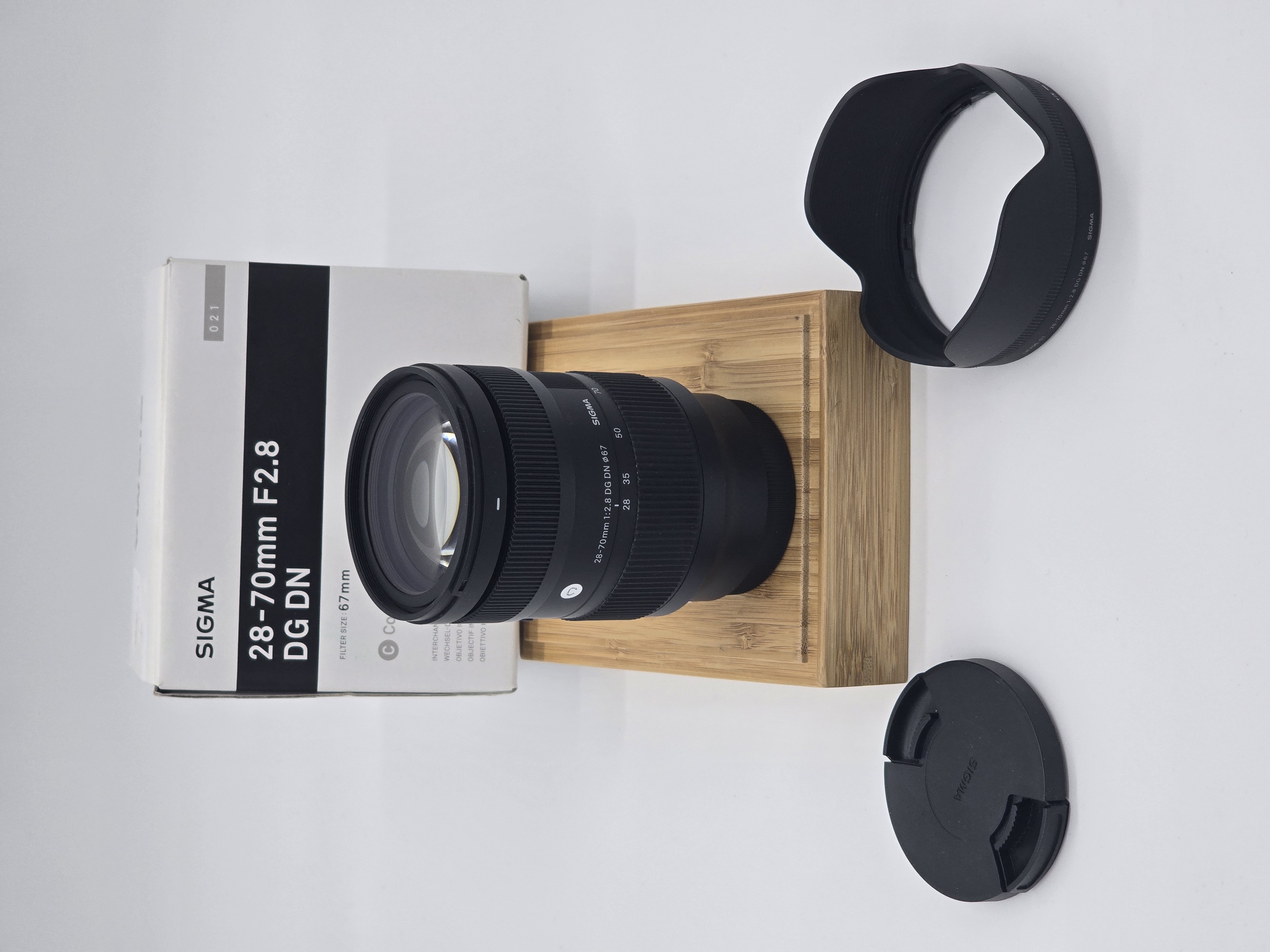
A kit zoom (for example 18–55 mm) is enough to start with and is often included in a used package. The biggest jump for little money, though, comes from a prime lens with f/1.8 aperture: around 30–35 mm on APS-C, 50 mm on full frame. You get a cleaner image, better performance in dim light and a blurred background that a kit zoom cannot deliver. How to inspect a used lens is covered in How to check a used lens.
In the long run the lens matters more than the body: you will replace the body in a few years, but a good lens stays with you.
What to look at on a used body
The basic check takes half an hour and reveals most problems. The full procedure is in How to check a used camera before buying; here are the essentials:
- the shutter count; on a body in this budget tens of thousands are normal and not a problem (how to find it is explained in the article on shutter count),
- a clean sensor and an undamaged lens mount,
- a display without dead pixels and controls without play,
- the original charger and a battery that holds its capacity,
- a test shot of a bright flat surface at f/11.
First settings that work
Leave full auto alone, but do not jump straight into manual either. A good start:
- Aperture priority (A or Av). You choose the aperture, the body calculates the shutter speed.
- Auto ISO with an upper limit of about 3200 on APS-C and a minimum shutter speed of 1/125 s. Noise at ISO 3200 is acceptable on a modern APS-C camera, a blurred photo is not.
- Autofocus: tracking AF (AF-C) with eye detection for people and animals, a single point in AF-S for landscapes and architecture.
- Format: RAW and JPEG at the same time until you get used to editing. The differences are explained in RAW or JPEG.
Rough values: landscape f/8, ISO 100, 1/250 s in sunshine. Portrait f/2 and 1/250 s. A child or dog in motion 1/500 s or faster at f/4. How aperture, shutter speed and ISO relate is in the article on the exposure triangle.
The most common beginner mistakes
- Chasing megapixels. For print and web 20–26 MP is plenty; only those who crop heavily need more.
- Three lenses instead of one good one. A single quality prime gives you more than a cheap zoom for every situation.
- Auto ISO without a limit. In dim light the body then climbs to needlessly high values.
- Buying blind. If you cannot try the body in person, ask for detailed photos, a picture of the display after switching on and a sample shot.
- No-name batteries and cards. You usually save a few hundred crowns and risk losing photos.
What I would do
I would choose a newer APS-C body with a tracking autofocus, add a fast prime and leave the rest of the budget for a card and a battery. Leave full frame for the moment when you realise APS-C is holding you back in something. What the e-shop currently offers is shown in the cards below, as an example of where the budget can be pushed. Tell me what you shoot and how urgent it is and I will help you pick a concrete option, or have a look at the offer.