
Buying advice
Street photography: light gear and fast focal lengths
Street photography thrives on speed and discretion. Which light gear and focal lengths around 35 mm fit, how to set them up for the street and which mistakes to avoid.
Street photography is built on speed and discretion. A moment on the street never repeats, and a big heavy camera with a huge lens makes you the center of attention before you press the shutter. That is why light gear and a single fast focal length around 35 mm pay off here. This article shows what gear to choose, how to set it up so it works without thinking, and which mistakes beginners make.
Why exactly 35 mm
It is the most universal reportage focal length. It is wide enough to include the context of the street and tight enough that a person in the picture still has an expression. It forces you to get close to the subject and work with space and composition, which on the street is more of an advantage than a drawback. An f/1.4 aperture also copes with the street at dusk, where lamps and neon shop windows create dramatic contrast.
If 35 mm does not suit you, there are two reasonable alternatives: 28 mm, which takes in more surroundings, or 50 mm, which is better for details and distance. 24 mm is already demanding on the street, requiring closeness and work with perspective. Specific lenses are covered in Sony FE 24 mm f/1.4 GM, Sony FE 28 mm f/2 and Sony FE 35 mm f/1.8 vs f/1.4 GM.

The body: smaller is better
On the street you do not want to carry a kilo and a half. Of what turns up on the used market, I would rank it like this:
- Sony A7C – compact full frame, smaller and lighter than the A7 IV, with good eye tracking. For street it is one of the most logical bodies.
- Sony A7 IV – bigger and heavier, but with better controls and a larger viewfinder. If you shoot other genres too, it is a universal body.
- Canon EOS R6 or R6 Mark II – very good in low light, but larger.
- Canon EOS R7 – APS-C, smaller and lighter than the full-frame bodies. The 1.6× crop turns 35 mm into roughly 56 mm, which is already tighter for street.
- Nikon Z6 II – a full-frame alternative with pleasant ergonomics.
For street, megapixels are not decisive; weight, a quiet shutter and one-handed operation are. Use the electronic shutter where nothing fast moves and the light is natural; under artificial light (LED, neon) it can cause banding.

Settings for the street
The street changes quickly, so the settings must be ready before the situation:
- Aperture f/5.6–f/8. On the street you do not want to be focusing at the last moment. At f/8 and 35 mm the depth of field is large: if you focus at 3 m, roughly 1.9 m to 7 m will be sharp. This is called zone focusing.
- Shutter 1/250 s or faster. People move, hands shake, and if you want sharp motion, go to 1/500 s.
- Auto ISO with an upper limit of 3200–6400. At night it is more important to have a sharp photo than clean shadows.
- Autofocus: in good light AF-S or AF-C with a small area; in zone mode manual focus at a preselected distance.
- Format: RAW. The street is contrasty and you will want the highlights and shadows.
- Silent shutter and beeps off. The body must not make noise.
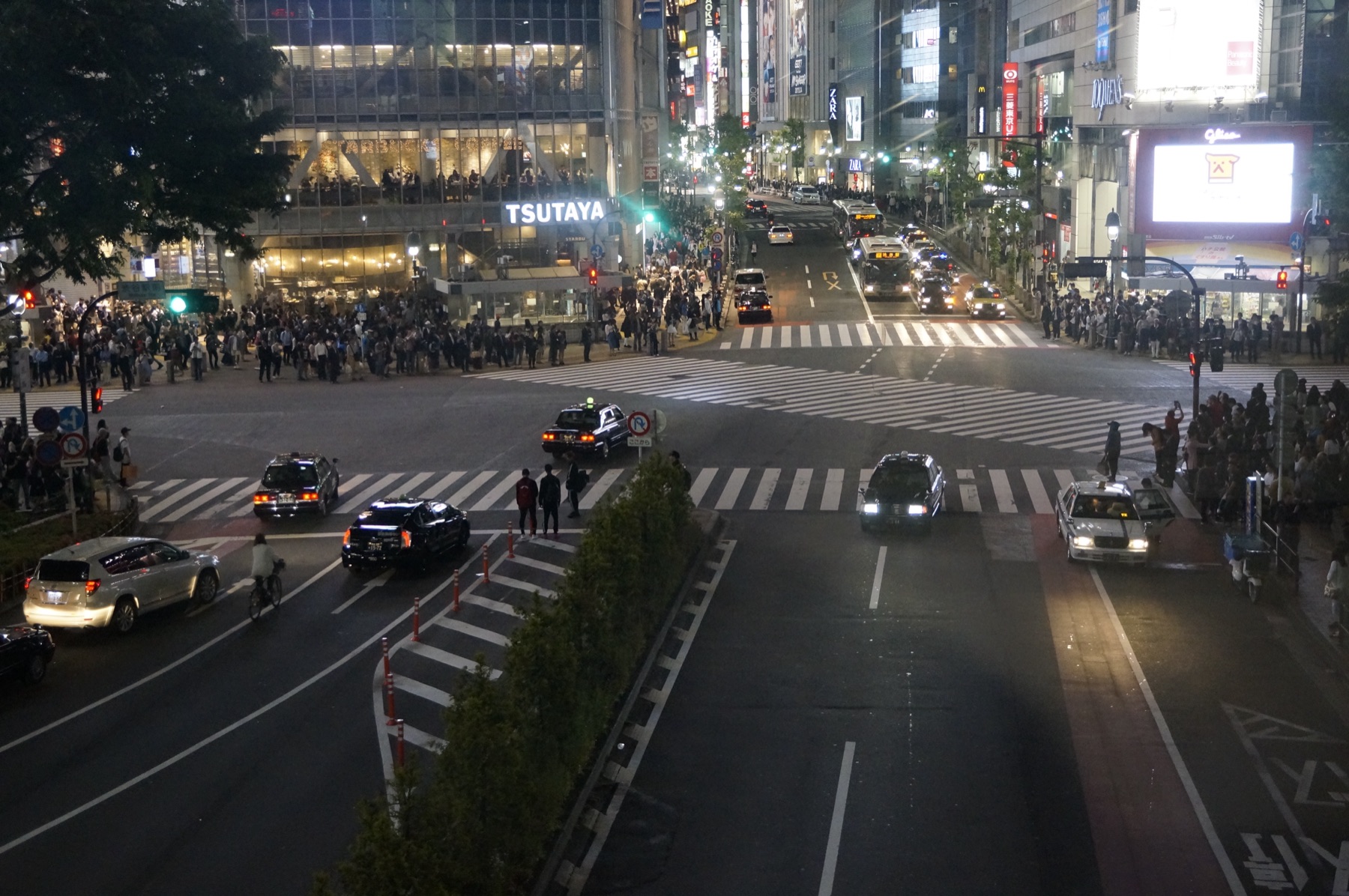
The photo above from Shibuya in Tokyo shows what a night street involves: at 33 mm, f/4.5 and 1/100 s it came out at ISO 3200. With a fast lens at f/1.4 roughly ISO 320–400 would do, but the depth of field would be much shallower.
Discretion and respect
The best discretion is simple: a small body, a small lens, no large lens hood and no flash. Approach slowly, smile and do not pretend you are not photographing. If someone avoids you or shakes their head, delete the photo. In some countries photographing people, and especially publishing photos with identifiable persons, is regulated, so inform yourself before a trip. A smile and a short gesture asking for permission help.
Typical beginner mistakes
- A lens that is too wide. 24 mm looks tempting, but the picture then falls apart into empty areas and nothing stands out.
- Wide open. f/1.4 looks impressive, but with moving people you will miss focus.
- Chasing a pricier lens. Light, composition and emotion matter more than glass. They make a good photo even without ideal gear.
- Shooting from the hip without checking. Zone focusing works, but on the first day verify that you really hit the mark.
- A heavy bag. One body, one lens, one spare battery. More only slows you down.
What I would do
For street I would take a small full-frame body and a fast 35 mm. I would work with f/5.6–f/8, 1/250 s and Auto ISO and zone focusing, and keep f/1.4 for the evening. What I currently have on offer you can see in the cards, and the whole offer is on the website. Tell me whether you want more discretion or maximum rendering, and I will advise.