
Review
Sony FE 24–50 mm f/2.8 G: a compact zoom that gives up the tele end
A standard f/2.8 zoom that saves 255 g against the 24–70 mm GM II in exchange for a shorter range. When it is a good deal, how to set it up and what to check on a used copy.
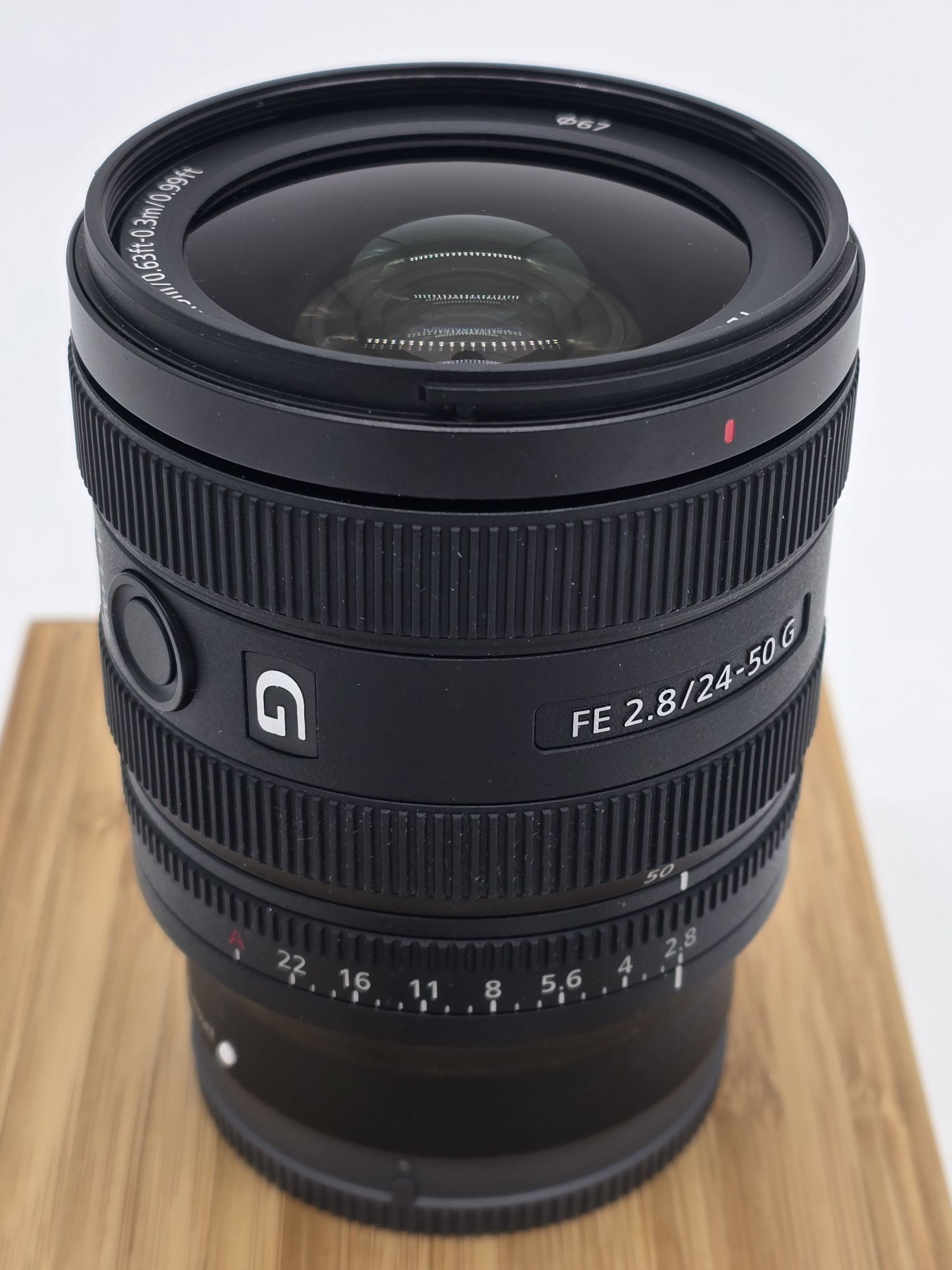
For years a standard zoom with f/2.8 meant one thing: 24–70 mm and nearly 700 g round your neck. In 2024 Sony came up with a different offer. The FE 24–50 mm f/2.8 G takes off the tele end and in return weighs only 440 g. The difference against the 24–70 mm GM II is 255 g, roughly a quarter of a kilo, which you really notice on an all-day walk. Here is who the trade-off suits, who will regret it, and what to check on a used copy.
What a shorter range means in practice
The 24–50 mm focal lengths cover most situations a standard zoom is bought for: landscape and architecture at the wide end, group shots, reportage, food on a table and a full-length figure at 50 mm.
You lose the 50–70 mm range, the classic half-length portrait. Anyone shooting people on commission uses this range all the time and will miss it. Anyone shooting travel, city and family often will not notice, and if they do, they take two steps forward.
The specifications that matter
- constant f/2.8 across the range,
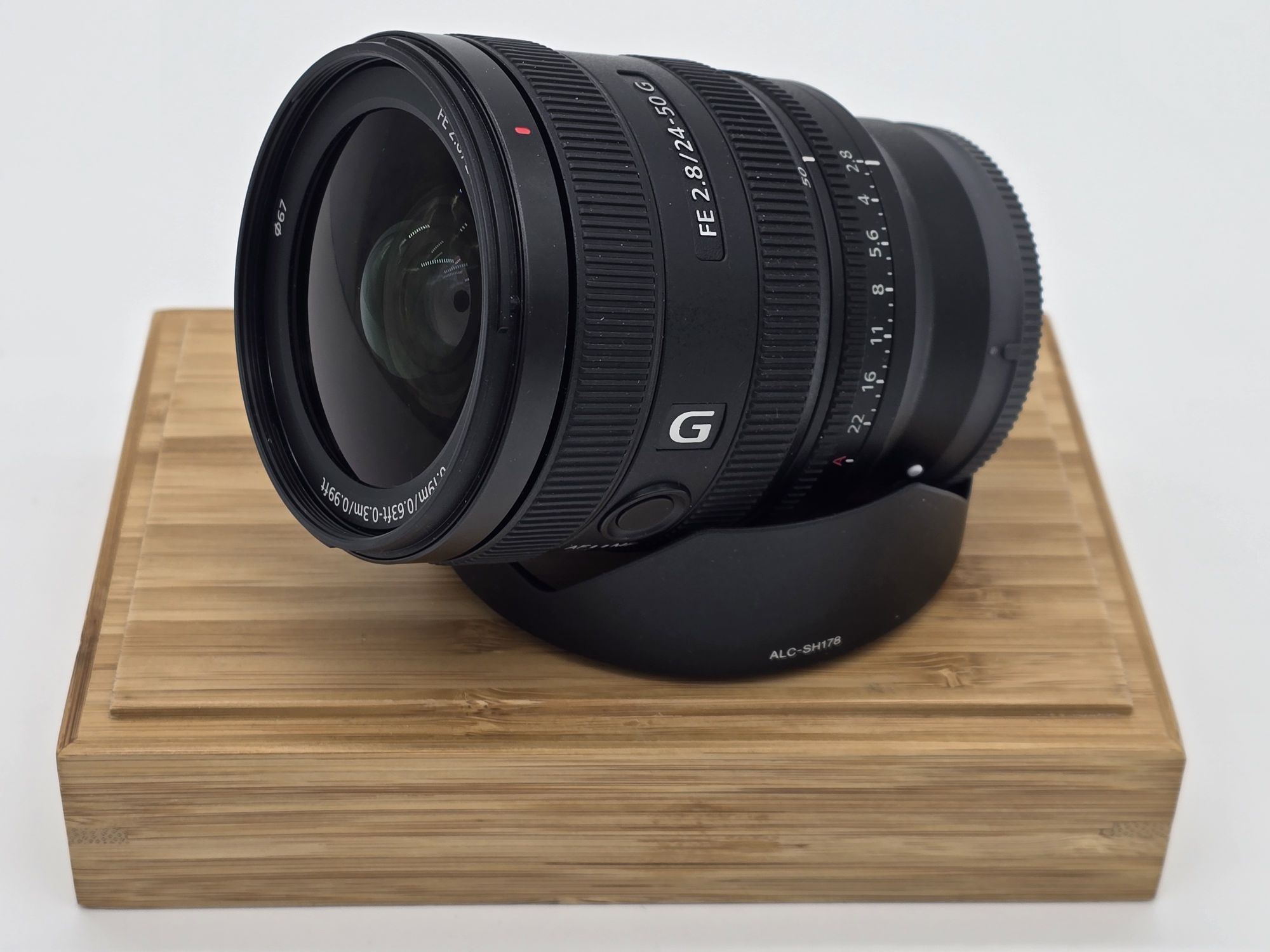
- weight 440 g, filter diameter 67 mm,
- closest focusing distance 19 cm (at 24 mm; about 30 cm at 50 mm) and magnification up to 0.30× with autofocus (0.33× with manual focus), so it handles semi-macro shots,
- an aperture ring,
- dust and moisture resistance.
Thanks to the short focusing distance and f/2.8 this zoom is surprisingly good for details. A magnification of 0.30× is more than most standard zooms offer, and in practice it replaces a separate lens for product and food shots.
Practical settings
- Travel and city: aperture f/5.6 to f/8, shutter 1/250 s, automatic ISO. At 24 mm and f/8, focus at about three metres and almost everything from two metres onward is sharp.
- Portrait at 50 mm: f/2.8 to f/3.5, shutter at least 1/200 s. Focus on the eye and switch on eye detection. At 50 mm and f/2.8 the background separation is less pronounced than with a fast 50 mm prime; expect a natural, softer blur.
- Details and food: focus close (from 19 cm at 24 mm, from about 30 cm at 50 mm) and f/4. A magnification of about 0.3× is enough for a flower or a plate.
- Video: f/4, 1/50 s at 25 frames per second, ISO to suit the light; the light kit on a gimbal is the main advantage.
Comparison: 24–50 G, 24–70 GM II, Tamron 28–75 G2
You decide mainly by weight and by where you need the range:
- 24–50 mm f/2.8 G: 440 g, the smallest and lightest, but it ends at 50 mm.
- 24–70 mm f/2.8 GM II: 695 g, full range and top optics, but the highest price.
- Tamron 28–75 mm f/2.8 G2: 540 g, a longer tele end, but it starts only at 28 mm.
If you miss 24 mm on the Tamron and do not want to carry a GM, the 24–50 G is exactly the compromise that remains. A detailed comparison of the Tamron and the GM is in Tamron 28–75 G2 vs Sony 24–70 GM, and the generations of the GM are compared in 24–70 GM II vs GM I.
Who it is for
It suits travellers, video makers and everyone who shoots every day and wants a light kit. It also works as a second lens on a body where you otherwise carry a prime.
It does not suit portraitists who work in the 50–70 mm range, nor sport and wildlife, where reach decides.
Typical mistakes
- Buying it as a replacement for the 24–70 mm. The loss of 20 mm at the tele end shows at the very first portrait.
- Expecting bokeh like a fast 50 mm prime. An f/2.8 zoom gives a different character than f/1.4; if the background is the priority, add a prime.
- Overlooking the minimum distance. The 19 cm (at 24 mm) is measured from the sensor, so there is less room in front of the lens, and the lens and its hood can shade the subject when you shoot close.
What to watch for when buying used
- Run through the whole zoom range and listen. The barrel must move smoothly, without grinding or play.
- Test focusing at the shortest distance, about 19 cm (measured from the sensor).
- Check the aperture ring for play and that the positions click.
- Examine the mount and the sealing gasket; this is a lens meant for frequent carrying.
- The lens has been on the market since 2024, so most copies will be well preserved. Ask for the proof of purchase and the packaging.
- Check corner sharpness at 24 mm at f/2.8 and f/5.6; a difference between the left and right side of the frame shows a displaced element. The whole procedure is in How to check a used lens.
What I would do
If I need a light kit for all-day walking and I mostly shoot landscape, city and travel, I take the 24–50 mm f/2.8 G. If I shoot people, I take a longer lens, either the 24–70 GM II or the cheaper Tamron 28–75. The Sony 24–50 G is a deliberate compromise: you trade twenty millimetres at the tele end for a quarter of a kilo in the bag. For travel, video and everyday shooting it is a good deal, for commissioned portraits it is not. What I currently offer is in the card below.
