
Review
Sony FE 135 mm f/1.8 GM: review of the royal portrait lens
The Sony FE 135 mm f/1.8 GM in practice: sharpness, bokeh, autofocus, its 950 g weight and what to look at when buying one used. When 85 mm is better.
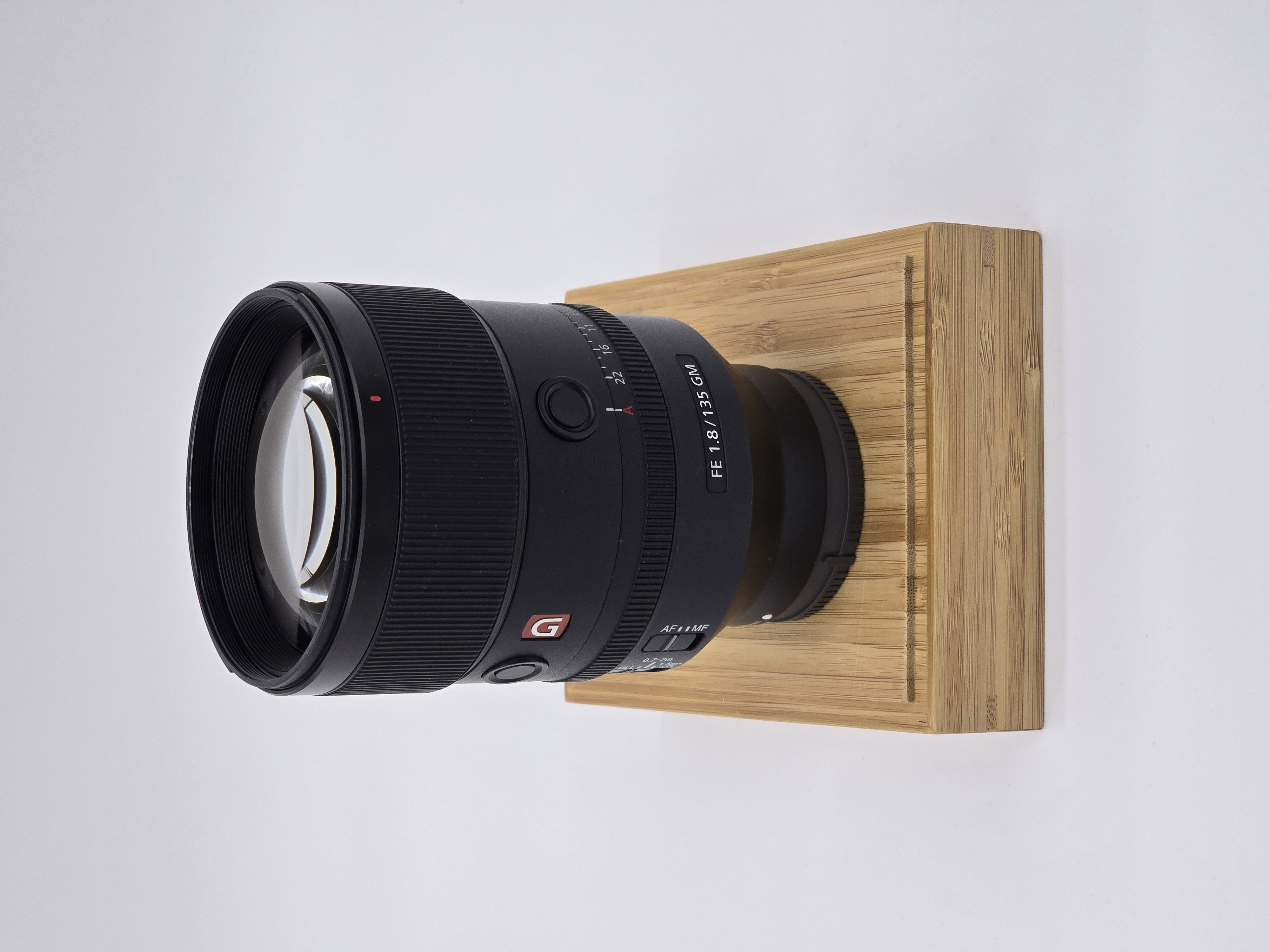
The Sony FE 135 mm f/1.8 GM is a portrait specialist and a lens for shooting where you want clear distance from the subject and softly blurred backgrounds. It is neither small nor cheap, but its rendering earns it a place in the bag of anyone serious about portraits. I go through where it is strong, what to criticise, how to shoot with it and what to look at when you buy it second-hand.
Why 135 mm for portraits
135 mm is longer than the classic 85 mm, so it has a different effect: the background is compressed and blurred more, and the face looks three-dimensional and undistorted. You cannot get as close to the model, though. For a head-and-shoulders portrait you stand roughly four to five metres away.
Distance from the scene is an advantage too: at an event or on the street you do not disturb people. The disadvantage is that in a cramped interior you have nowhere to step back to and cannot fit the model in the frame.
At f/1.8 the depth of field at four metres is only around 10 cm. In portraits that gives pleasant blur, but it demands accurate focus on the eye.
Optical quality
As a G Master member the 135 mm f/1.8 GM offers high optical performance. The image is very sharp in the centre from wide open and good in the corners; stopping down a stop or two adds only a small improvement. Colour fringing is controlled, and contrast and colours are typical for Sony – true and natural.
Bokeh and rendering
Here the lens really shines. The 11-blade aperture forms a round opening, out-of-focus highlights stay round when stopped down and the background melts softly without distracting elements. The transition between the sharp plane and the background is smooth even wide open at f/1.8, which is why portraits look "painterly".
Autofocus
The lens focuses with XD linear motors, quickly and quietly. It reliably catches movement, which you appreciate with children, animals or at events. Eye tracking with a more modern body works very well. Focus breathing is small, so it also suits video.
On the lens you will find a focus range limiter (limits hunting at close range), focus-hold buttons and an aperture ring with a click switch.
Practical settings
For a portrait outdoors start at f/2 to f/2.8, which gives plenty of blur and a better chance that both eyes are sharp. Leave ISO on auto with a minimum shutter speed of 1/250 s, focus on the eye of people or animals and choose a smaller focus zone so that focus does not lock onto hair. Because depth of field is shallow, a burst of two or three frames also helps.
Weight and practice
This is the biggest objection: the 135 mm GM weighs about 950 g and takes an 82 mm filter. You will feel it at an all-day event such as a wedding, especially on a small body. Handheld I recommend 1/250 s or faster; in-body stabilisation helps, but do not rely on it for a portrait with movement.
On an APS-C body the 135 mm behaves like roughly 200 mm, which is usable for bands and sport but often too long for portraits.
What to check on a used unit
- the front element: scratches, wear, dust inside against the light,
- the aperture ring, the click switch and the focus-hold buttons,
- the focus range switch and the AF/MF switch,
- a smooth focus ring without stuttering,
- decentring: a photo of a flat wall at f/1.8, where both sides must be equally sharp,
- the lens hood: it seats without play,
- real focusing: a few portrait frames with the eye on the axis, checked at 100%.
The detailed procedure is in How to check a used camera before buying.
What I would do
Shooting portraits outdoors, at events or weddings and want strong distance? I would take the 135 mm GM, because few other lenses process a background like this. Mostly in a studio or small spaces? Take the Sony FE 85 mm f/1.4 GM instead. Is the weight a problem for you? Try a longer zoom, such as the Sony 70–200 mm GM.
More pieces are in the e-shop.