Comparison
Sigma 24–70 mm f/2.8 Art vs. Art II: is the second generation a must?
Sigma 24–70 mm f/2.8 DG DN Art versus Art II: differences in weight, autofocus and optics, a used-copy checklist, and when the first generation is enough.
The Sigma 24–70 mm f/2.8 DG DN Art has built a reputation over the years as one of the best zooms for mirrorless cameras outside the camera makers' own lines. The second generation, the Art II, came with better autofocus and lower weight, and the question now is whether it is worth the extra money. I go through the differences that show up in practice and add what used buyers care about: what to check and when the first generation is enough.
What the second generation brought
The most visible change is weight. According to the manufacturer the Art II is roughly 90 g lighter than the first generation (745 g versus 835 g). On a zoom you carry all day on a mirrorless body, you feel that. The second generation also has revised controls and a new design, so it feels more modern in the hand.
Replacing the first generation just for looks makes no sense, though. Optically the Art I is still a very good lens and the metal barrel feels like quality.

Autofocus: where the difference is largest
The second generation uses a newer motor and, according to the manufacturer and tests, focuses faster and more smoothly than the first. You see it when tracking movement: sport, kids, birds or video, where the Art II holds focus better. For portraits, landscapes, architecture and reportage at a calmer pace, the Art I is usually fast enough.
A practical note: with an older body and slower AF the difference between generations is smaller, because the limit is in the body. On new bodies with subject tracking the generations differ more.
Optical quality
In sharpness the two generations are close. The Art II has, according to available information, slightly better corner correction and less distortion, mainly at the wide end. For landscape and architecture look at the corners at f/2.8 and f/4; for portraits and reportage the difference is hardly visible. Both versions are excellent in the centre from the open aperture.
When choosing, rely on your own test rather than on charts: photograph a flat wall or a regular pattern at 24, 35 and 70 mm and compare the corners.
What to check on a used copy
For both versions:
- the zoom ring runs smoothly and the barrel does not extend on its own,
- focusing makes no odd noises and does not grind,
- on a flat wall at f/2.8 all corners should be similarly sharp,
- the front element without scratches or worn coating, no haze inside,
- the mount without play and the contacts clean,
- confirm which mount the copy is made for (Sony E or L-mount), because Sigma makes both versions.
Also ask whether the copy has ever been serviced and whether the seller knows of any repair after a drop. Be sure to try the lens on your own body and confirm that it communicates without errors and that autofocus lands well on an eye and on detail, both at 24 mm and at 70 mm.

Practical settings
For landscape and architecture go to f/5.6 to f/8 on a tripod or from a stabilised body; around 1/125 s at 24 mm you can manage handheld. For portraits or reportage indoors f/2.8 at ISO 800 to 3200 and 1/125 s is enough. At 70 mm remember the reciprocal rule: at least 1/80 s, or slower with modern stabilisation.
Price and the used market
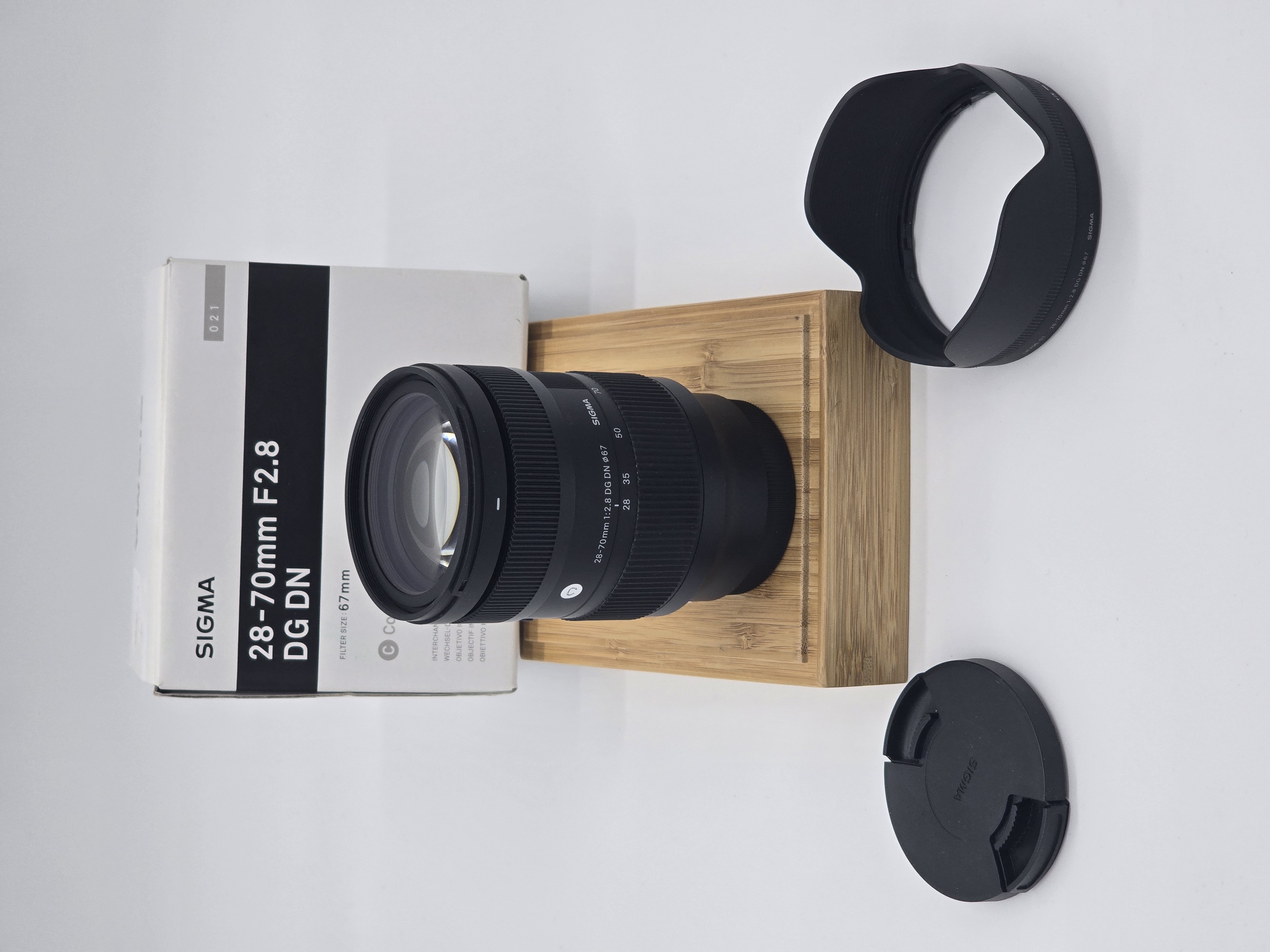
The Art I is noticeably cheaper than the Art II on the used market, and that is exactly where it makes sense: most of the performance for sensible money. The Art II is newer, which means more remaining life and better AF, but also a higher price. If you want to go cheaper and lighter, consider the Sigma 28–70 mm f/2.8 Contemporary too, which is noticeably lighter and smaller, only with a narrower range; a copy is in the cards below. For other alternatives see the articles on the Tamron 28–75 mm versus Sony 24–70 mm and on the Sony GM II versus GM I.
What I would do
For static work, landscape, architecture and portraits I would take the first generation and put the saved money into lights or a tripod. I would choose the second generation for sport, kids and video, or for those who carry the lens all day and 90 g makes a difference. What I have on offer right now appears in the cards below; the full range of used lenses is in the e-shop.